Ramon Hoffman

Thinkwave

A strategy game that teaches you how to take an idea from concept to market.

01

The Brief

Eindhoven Engine (a collaborative organization of TNO, Fontys, and TU/e) had built up real research into how successful innovation projects are structured. They wanted to turn that knowledge into a playable game: something teams could use in workshops to learn how to bring a product from idea to market. The result needed to feel like a genuine game, not a dressed-up checklist.

02

My Approach

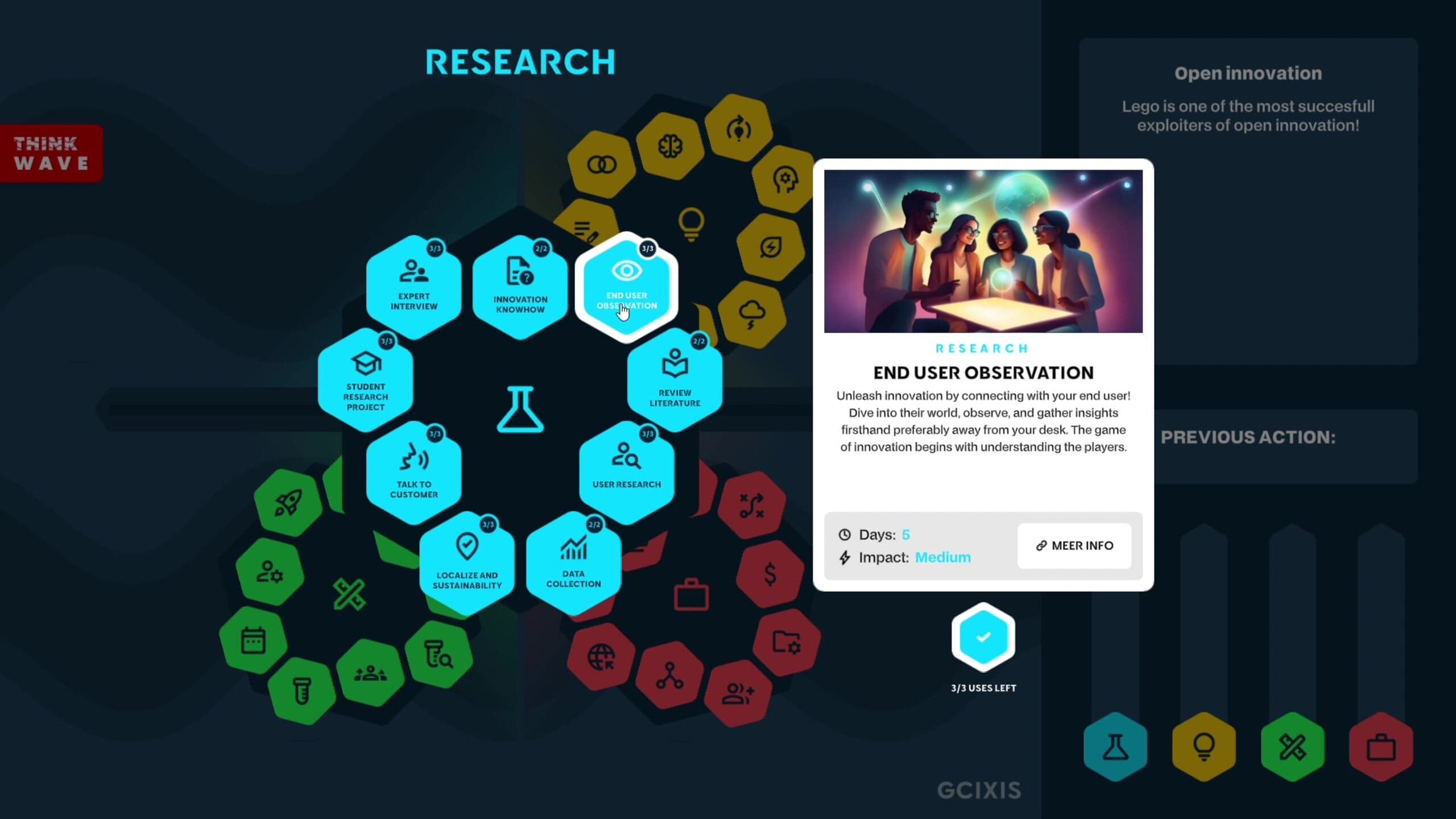
The game runs in PlayCanvas and simulates a 500-week innovation timeline. Players choose actions across four disciplines: Research, Ideation, Development, and Business. Each action takes time off the clock and adds impact points to its category. The interesting wrinkle is that the impact formula rewards balanced investment. Stacking one category gives diminishing returns because each action's output is scaled by how close that category's current score is to a predefined "sweetspot." Players who spread their choices strategically score higher than those who specialize early.

All game content (action names, descriptions, durations, impact values, tips, and end-screen text) lives in a Google Sheet and is fetched at runtime via PapaParse. Nothing is hardcoded, so Eindhoven Engine can update copy or rebalance actions without touching the code.

A few less obvious problems came up during development. PlayCanvas doesn't have a CSS-style stacking system, so when a category card expands to show its actions, each element had to be manually moved to a dedicated "Front" render layer to appear above the overlay, then reassigned back on collapse. Expand and collapse animations all route through a centralized tween system that temporarily locks interaction during motion. Pivot-based scaling also required storing each entity's original pivot offset at initialization, because tweening directly to (0.5, 0.5) without that reference would cause cards to jump position.

Session data is saved server-side and restored on return. Because the game is hosted on a separate domain from the save endpoint, a hidden iframe with a form POST handles the write without triggering cross-origin errors.

My colleague handled the UI design. I built the full game logic, data pipeline, session system, and PlayCanvas implementation.

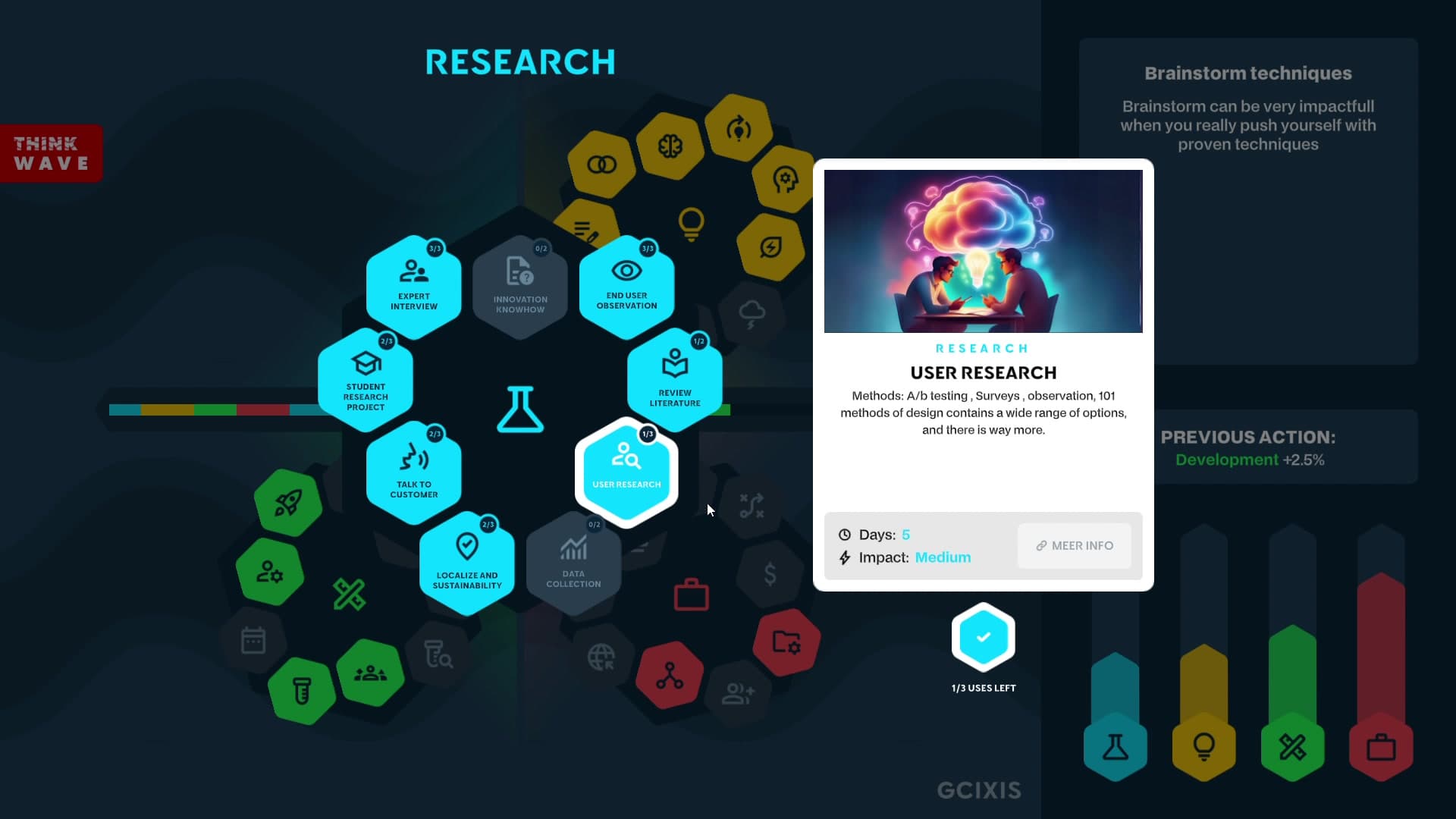
Late-game Research board with several actions spent. User Research is selected, showing 1 of 3 uses remaining. The growing number of grayed tiles signals that the available action pool is narrowing.

Fig. 03

Late-game Research board with several actions spent. User Research is selected, showing 1 of 3 uses remaining. The growing number of grayed tiles signals that the available action pool is narrowing.

03

The Result

A browser-based strategy game where teams manage an innovation project over a simulated timeline, choosing from over 30 actions across four disciplines. Three intermission screens fire at key milestones to give feedback mid-game, and a final "newspaper" reveal shows each category's outcome. The game can be resumed across sessions and the entire content layer is editable from a single Google Sheet without a code deploy.

04

Outcome

Thinkwave has been played over a thousand times and is still actively in use by Eindhoven Engine. It was a strong collaboration from the start: Eindhoven Engine came in with clear research and good instincts about what they wanted the game to feel like, the designer translated that into a clean visual direction, and the development came together without major friction. One of the more satisfying projects to ship.

Video · 1 clip

Fig. 05 · Video

A look at the Business category in play, weighing higher-cost actions against the timeline.

Ramon Hoffman, Multimedia Designer / 3D Artist / Web Developer

03 / About

Concept first, medium second

I'm Ramon, a multimedia designer based in Eindhoven. Projects start with a problem: what the thing has to do, and how someone should move through it. The answer has been a 360 film, a VR walkthrough, an explainer animation, a configurator and an AI training platform.

My part is 3D, design and code: modelling and lighting in Blender, interface and motion in XD/Illustrator and After Effects, and the build in PlayCanvas or Next.js.