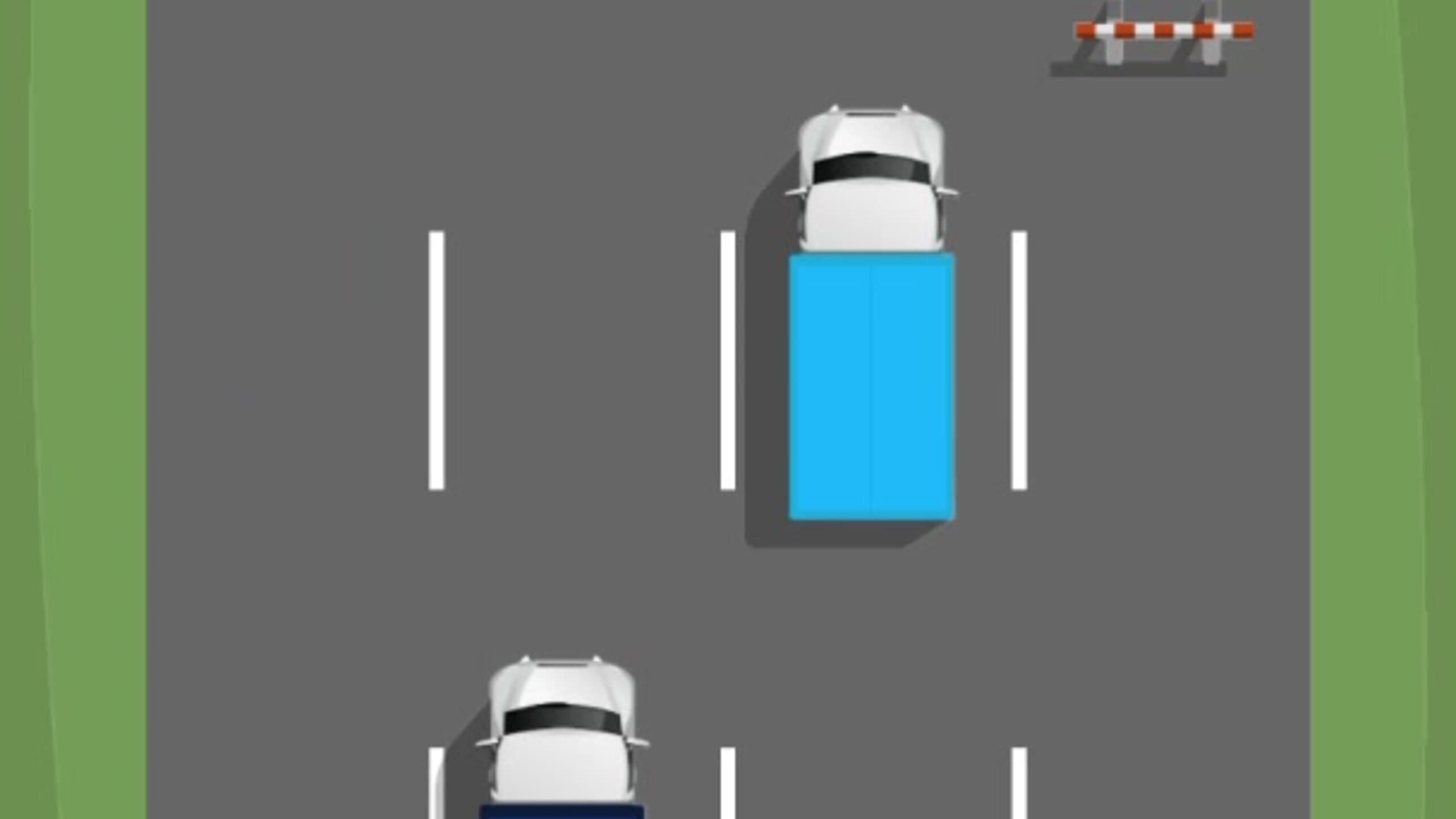
Delivery Dash
A two-player delivery truck race for Sendcloud's trade show booth, with 90-second rounds and four powerups to push your opponent into last place.
01
The Brief
Sendcloud wanted a game for their trade show booth that is competitive, easy to pick up and fun to play against someone else. A daily top-5 leaderboard gives people a reason to come back and beat their score.
02
My Approach
Two players race Sendcloud delivery trucks up a four-lane road. The front row scores about ten times more than the back, so staying ahead is everything and falling behind hurts. Each truck moves between cells on a grid, which keeps collisions simple, because an occupied cell just blocks the move. Four powerups keep it chaotic, each picked by a quick slot-machine animation. There's a boost, an oil slick, a net that pins your opponent and a swap that trades places, which is brutal when you're in last. The road speeds up as the round goes on, with obstacles placed fresh on every stretch, and it plays with keyboard or gamepad. Scores are kept per day, and staff can reset them each morning.
03
The Result
I built the game solo. It's a 90-second, two-player race on a shared screen, with a daily leaderboard.
04
Outcome
The booth drew a crowd, with players and spectators both getting into it, which is what you want from a game at a live event.
Video · 1 clip
Fig. 04 · Video
The final seconds, the winner screen and the daily leaderboard.

03 / About
Concept first, medium second
I'm Ramon, a multimedia designer based in Eindhoven. Projects start with a problem: what the thing has to do, and how someone should move through it. The answer has been a 360 film, a VR walkthrough, an explainer animation, a configurator and an AI training platform.
My part is 3D, design and code: modelling and lighting in Blender, interface and motion in XD/Illustrator and After Effects, plus the build in PlayCanvas or Next.js.