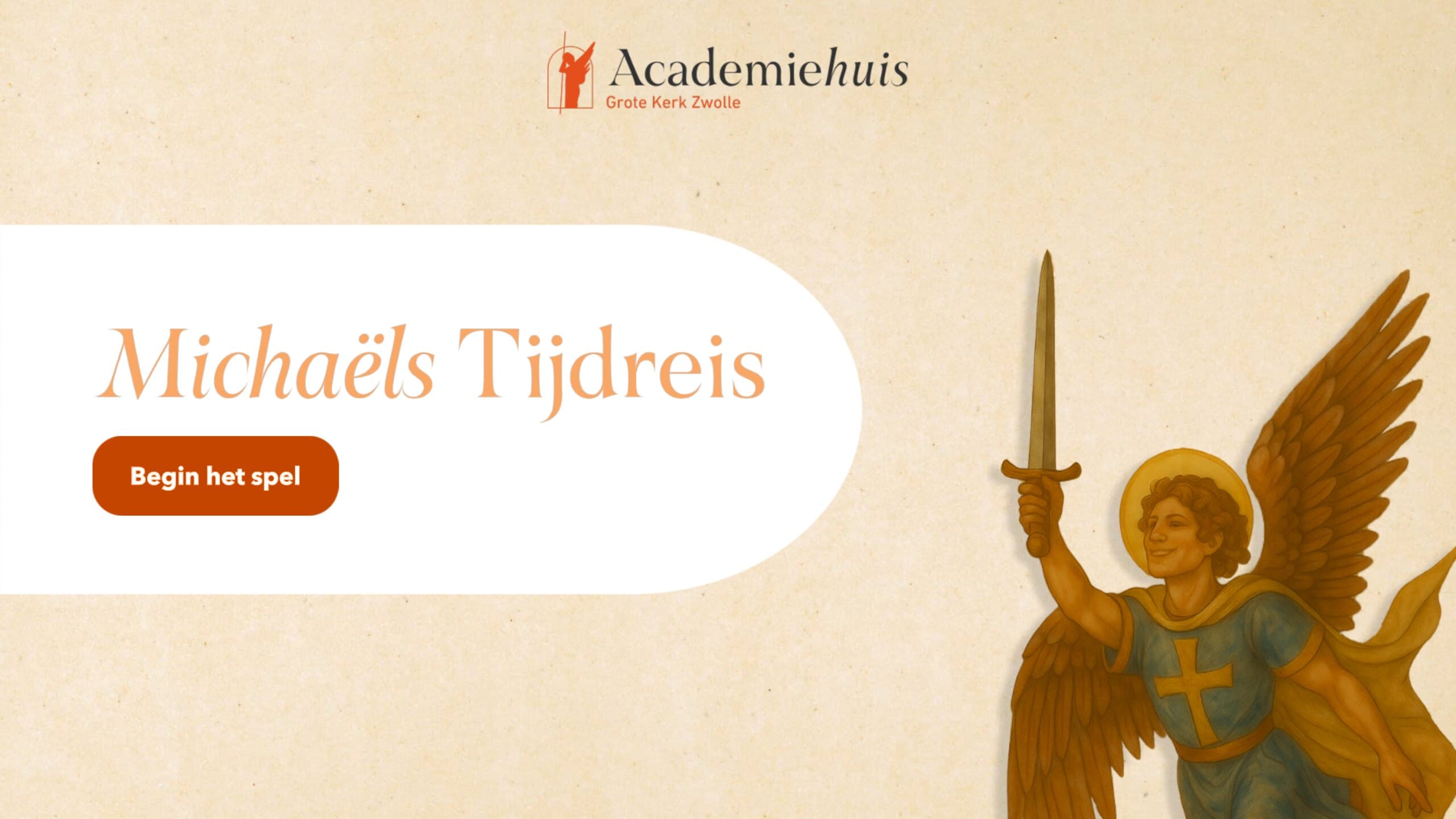
Academiehuis
A location-based tablet game that guides kids through a 600-year-old church using puzzles and a fallen angel.
01
The Brief
Academiehuis is a cultural center inside the Grote Kerk, a 600-year-old church in Zwolle. They wanted to make school visits more engaging with a game on their own tablets, one that keeps kids moving through the church while teaching them about its art, architecture and history. The wifi inside the thick stone walls is bad, and the kids had to stay interested across 9 stops.
02
My Approach
Kids follow the angel Michael, who has fallen and lost his memory. An animated map shows where to go next, and at each stop a puzzle ties into something that's physically there. I built 6 of the 9 puzzles, including a Tetris-style game that rebuilds the oldest wall, a maze in the memorial chapel and one where you carve into a school desk while the teacher isn't looking. I also made a drag-and-drop template a colleague used for two of his. Michael's story plays in short videos between stops. Loading them all at once would crash the tablets, so each video loads two stops ahead and unloads once you've passed.
03
The Result
The finished game runs on the church's own tablets. Kids walk through the real building and piece together Michael's lost memories across 9 puzzles.
04
Outcome
The game is in active use for school visits, and the client was happy with how it keeps kids engaged in a building they might otherwise zone out in. For me, building for simple tablets on bad wifi meant solving problems I hadn't run into before.

03 / About
Concept first, medium second
I'm Ramon, a multimedia designer based in Eindhoven. Projects start with a problem: what the thing has to do, and how someone should move through it. The answer has been a 360 film, a VR walkthrough, an explainer animation, a configurator and an AI training platform.
My part is 3D, design and code: modelling and lighting in Blender, interface and motion in XD/Illustrator and After Effects, plus the build in PlayCanvas or Next.js.